

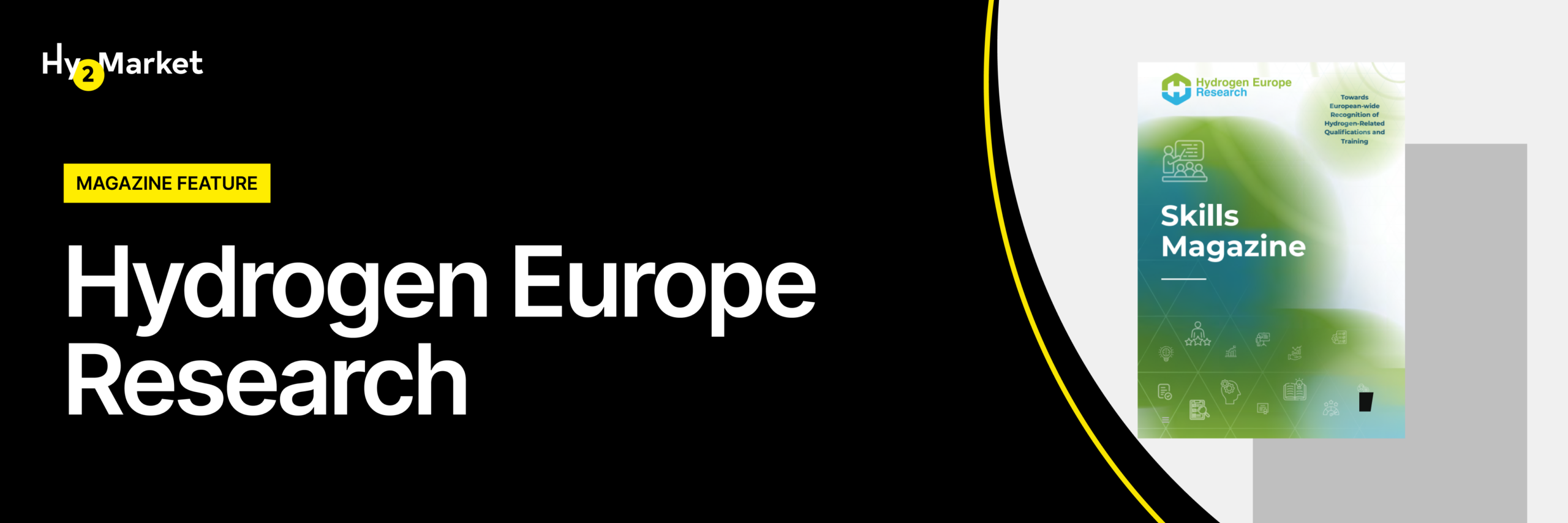
Hy2Market Findings on Hydrogen Skills Featured in HER Skills Magazine
Hydrogen Europe Research published its Skills Magazine on October 27th, and Hy2Market is among the featured projects. The autumn edition, “Towards European-wide Recognition of Hydrogen-Related Qualifications and Training,” combines a white paper with stories from the association’s members about their education and training work. The white paper looks at how hydrogen qualifications can become more transparent, comparable and portable across Europe. The Hy2Market article appears in the EU Projects section on pages 40-41.
Is Europe’s Workforce Ready?
Hy2Market brings together 42 partners and is funded through the Interregional Innovation Investments programme. The project connects regions with strong hydrogen production potential to regions where demand is growing. Alongside investing in technology and infrastructure, the partners asked a central question: Is Europe’s workforce prepared to plan, build and operate the hydrogen economy safely and effectively?
To answer it, the team mapped and compared existing training programmes in the Netherlands, Austria and Greece. It also surveyed 38 partner organisations about the knowledge needed for 14 roles. These ranged from engineers, operators and safety specialists to project managers, finance and purchasing staff, and senior management.
No Single Set of Hydrogen Skills
The study shows that each role needs something different:
- Engineers need in-depth technical, material and process knowledge.
- Operational staff rely on hands-on experience, equipment-specific knowledge and a strong safety mindset.
- Non-technical employees need enough basic knowledge to assess contracts, projects and strategic decisions.
Formal education remains important, but much of the competence in hydrogen projects is built on the job. It comes from mentoring, cooperation between departments and learning from experienced colleagues. External courses are still essential in fast-moving areas such as safety, regulations and technical standards. However, partners identified cost as a barrier, especially where specialist training is offered mainly by private providers.
From Findings to Practical Guidance
Based on these results, Hy2Market’s “Training Guidelines” recommend role-specific learning pathways rather than one programme for all employees. Under this approach, a company can:
- Identify the key tasks of each role, such as carrying out safety checks, operating equipment or responding to an incident.
- Turn those tasks into short modules that combine theory, guided practice and a simple assessment.
- Support new employees through structured mentoring.
- Keep a basic competence record that shows when a task was observed, assisted and completed independently.
The guidelines also encourage companies to include workforce planning from the start of every hydrogen project.
Western Macedonia, Greece, shows why this matters. As the region moves away from lignite, many workers bring strong energy-sector experience but little exposure to hydrogen. Cooperation among regional organisations, universities and training centres is helping connect that experience with the needs of future hydrogen projects.
Europe’s hydrogen transition will move only as fast as its people can learn, adapt and work together.
Read the Full Hy2Market Article and the Complete Skills Magazine: Hydrogen Europe Research Skills Magazine (HER)
Hydrogen Europe Research members involved in Hy2Market: Wiva P&G, Aragon Hydrogen Foundation, Austrian Institute of Technology and ERIG.