

Hy2Market Completes a Detailed New Model of Its Power-to-Methane Process
Hy2Market partner ProzessOptimal has completed a comprehensive new simulation model of the project’s power-to-methane process — the system that converts renewable hydrogen and captured CO₂ into synthetic natural gas. Delivered under Work Package 2, the model supersedes an earlier, simplified version used during the process’s design phase and marks a significant step in the project’s technical maturity.
The new model is grounded in extensive measurements from the project’s own pilot plant from Hy2Market partner Montanuniversität Leoben, giving the consortium a far more reliable basis for understanding how the process behaves under real operating conditions. That foundation supports more efficient reactor operation, informs planning for a larger-scale installation, and strengthens the project’s ability to diagnose and resolve issues as the technology advances toward commercial deployment.
The Process, in Brief
The system builds on equipment already in operation at the steel plant of partner voestalpine Stahl GmbH in Linz, Austria. An electrolyser produces green hydrogen from water using renewable electricity, while a separate unit captures carbon dioxide from the power plant’s exhaust gas. The two gases are then combined in a reactor system and converted into synthetic natural gas, a gas fully interchangeable with the natural gas already used across homes and industry.
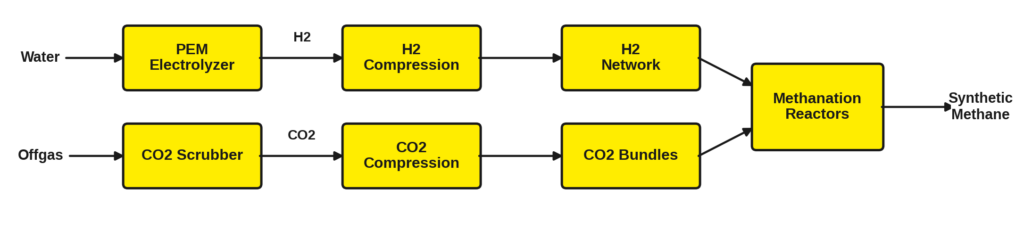
Figure 1: The overall Hy2Market power-to-methane process: hydrogen from the electrolyser and CO₂ from the power plant off-gas are combined in the methanation reactors to produce synthetic natural gas.
Converting hydrogen and CO₂ into methane is a strongly exothermic process, releasing considerable heat. The reactor is therefore actively cooled, maintaining stable operating conditions and protecting the catalyst that drives the reaction.
Validating the Model Against Pilot-Plant Performance
Rather than relying on theoretical assumptions alone, the project team validated the model against an extensive body of measurements drawn from the pilot plant, giving it a rigorous, evidence-based foundation. Building on that validation, the team then conducted a series of sensitivity studies to characterise how the reactor performs under different operating strategies — namely, recycling a portion of the output gas, adjusting the cooling regime, and varying operating pressure.
Maintaining Safe Reactor Operation
A central consideration for the model was capturing how the reactor’s peak temperature behaves, since the catalyst inside performs reliably only within a defined temperature range. Under unmanaged operating conditions, the reactor would readily exceed that safe threshold.
Recirculating a portion of the output gas back to the reactor inlet moderates the peak temperature by distributing the reaction’s heat more evenly across the catalyst bed. The team evaluated two recycling strategies — recycling the gas before or after removing the water it contains — across a range of recycling levels.
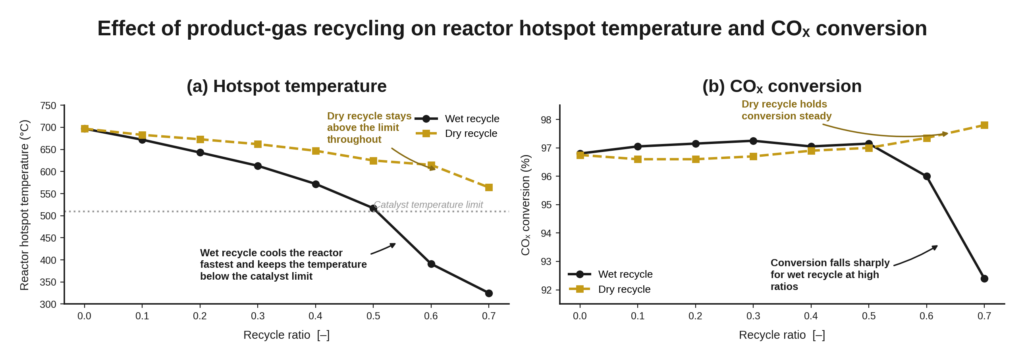
Figure 2: (a) Wet recycle cools the reactor fastest, bringing the hotspot down below the catalyst temperature limit at higher recycle ratios, while dry recycle stays above the limit throughout. (b) That extra cooling comes at a cost: COₓ conversion falls sharply for wet recycle at high ratios, while dry recycle holds conversion steady and even improves slightly.
Both strategies reduce peak temperature, but with materially different trade-offs. Recycling gas that retains its moisture cools the reactor more quickly, but at the expense of conversion efficiency — the water content shifts the reaction balance away from methane formation. Recycling drier gas produces a more gradual temperature reduction, but preserves — and in some cases slightly improves — conversion efficiency, since it behaves largely as an inert diluent rather than interfering with the underlying chemistry.
The Combined Influence of Cooling and Pressure
The team also examined how the reactor’s cooling regime and operating pressure influence performance, again testing across a range of recycling levels.
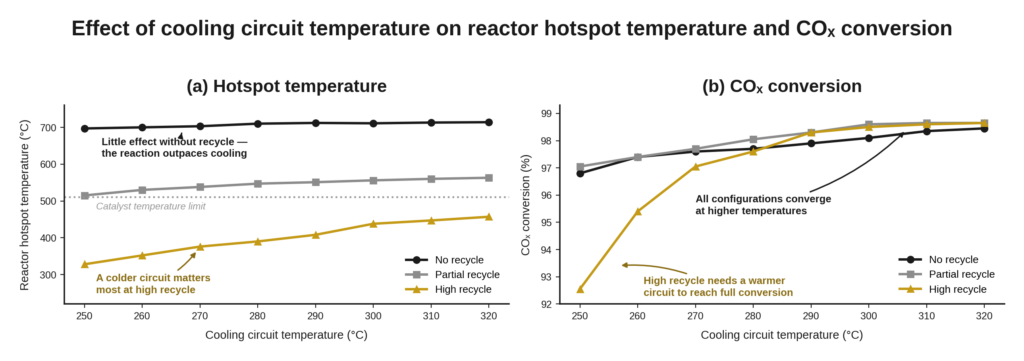
Figure 3: (a) Without recycle, the cooling circuit has little effect on hotspot temperature, since the reaction outpaces cooling; with a high recycle ratio, a warmer circuit allows the hotspot to rise while staying comfortably below the catalyst limit. (b) At a high recycle ratio, COₓ conversion needs a warmer circuit to reach its full value; all three configurations converge to a similarly high conversion at the warmest circuit temperature tested.
Operating pressure proved to be a more direct lever: higher pressure improves the conversion of CO₂ and hydrogen into methane, though it correspondingly raises the reactor’s peak temperature — reinforcing the operational value of gas recycling as a complementary control mechanism.
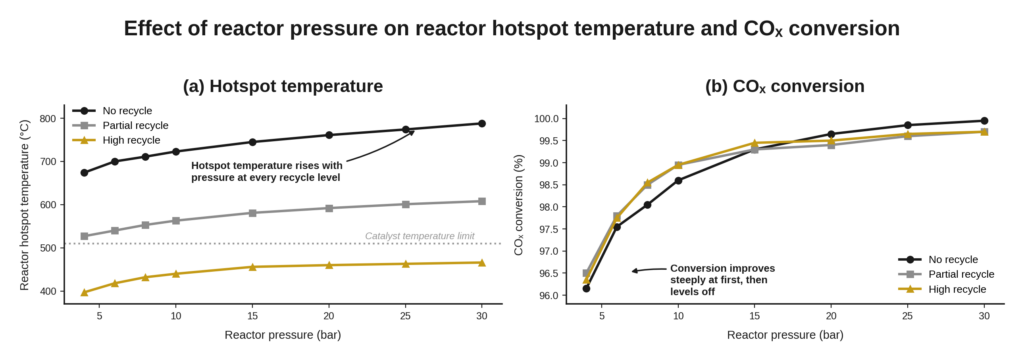
Figure 4: (a) Reactor hotspot temperature rises with pressure at every recycle level tested. (b) COₓ conversion improves steeply at lower pressures, then levels off at higher pressures, with the recycling strategy making little further difference once conversion is high.
Taken together, these sensitivity studies point to a well-defined operating strategy: a measured degree of dry-gas recycling, combined with an appropriately tuned cooling and pressure regime, sustains high conversion efficiency while preserving a comfortable safety margin below the catalyst’s temperature threshold.
Meeting Gas-Grid Quality Requirements
For the synthetic methane to be injected into the Austrian natural gas grid, it must comply with the same quality standards applied to any gas entering the network. The study confirms that this specification can be met through a modest adjustment to the hydrogen feed ratio, and importantly, without compromising the reactor’s overall methane yield.
What Comes Next
The completed model will now inform further Hy2Market work assessing the process’s techno-economic and environmental performance, and will continue to support the project as the technology advances toward full-scale operation at the Linz site.